Sri Lanka's $50M digital push is opening 100,000 jobs — but only for skill-ready graduates
Sri Lanka is at an inflection point. A $50 million government-backed digital transformation programme is projected to generate 100,000 digital job openings across the country in 2026 — the largest concentrated graduate hiring opportunity in the country's recent history. But the graduates who stand to benefit are not necessarily the ones with the highest grades. They are the ones who can prove they can do the work.
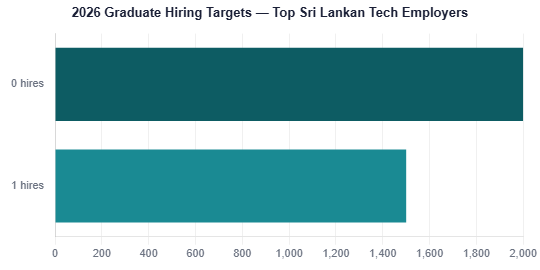
Virtusa, one of Sri Lanka's largest technology employers, has publicly announced a target of 2,000 new hires in 2026. IFS, the enterprise software company with its global R&D headquarters in Colombo, needs 1,500 cloud specialists this year alone. Both companies have been explicit in industry interviews and hiring advertisements: they prioritise Python proficiency, AWS certifications, and business communication skills over degree classification. A first-class degree from a state university carries weight in 1998. In 2026, the signal has shifted.
This matters because Sri Lanka graduates approximately 110,000 students from state universities each year. The vast majority enter the job market with a CV that lists a degree, a university, and a GPA. None of that tells Virtusa or IFS whether the candidate has written a line of Python, configured a cloud environment, or can explain a technical decision to a non-technical stakeholder. The signal is broken — and the graduates who fix it first win.
The structural challenge is real. Sri Lanka's state university system is theory-first by design. The focus is academic knowledge delivery: lectures, exams, textbooks. The tools, the projects, the hands-on application — those are largely absent. A computer science graduate from the University of Kelaniya may have never built a deployed application. A business graduate from the University of Sri Jayewardenepura may have never run a real financial model. This is not a failure of intelligence or effort. It is a structural gap between what the education system delivers and what the market needs in 2026.
What makes this moment different is that the demand is specific and the gap is closeable. Python is learnable. AWS has structured certification paths. Business writing is a practised skill. Graduates who recognise the shift and act in the next quarter will enter the 2026 hiring window with a differentiated profile — not just a degree.
For graduates in non-Colombo districts, this digital hiring wave is particularly significant. The $50M programme includes regional infrastructure investment, and remote-capable digital roles are increasingly district-agnostic. A graduate from Jaffna or Matara with verified cloud skills is as competitive for a Virtusa remote engineering role as a graduate from Colombo — if their profile shows it.
The action is clear: identify the two or three skills most relevant to your target industry, find a structured certification path for each, and build a profile that shows completion — not just enrollment. The 100,000 openings are real. The graduates who walk through them will be the ones who showed up with more than a degree.